
Publications
The MS-DVA Toolkit for Healthcare Professionals
Our updated MSDVA toolkit is now available! Click on the image below to access the full version.
 The MS Domestic Violence and Abuse Research Initiative has developed a toolkit for healthcare professionals working in MS care. The information and guidance within this toolkit will enable healthcare professionals (HCPs) to safely identify and respond to signs and disclosures of domestic violence and abuse (DVA) in their work with people affected by MS.
The toolkit also provides resources to help HCPs in signposting and referring their patients to specialist support if required. The toolkit is grounded in real-world clinical practice and was co-developed in consultation with pwMS, HCPs, and National Health Service (NHS) Safeguarding teams. It is available as a digital file or we can send you printed copies, whatever you prefer.
We are now looking for clinical sites who can work with us to implement the toolkit in their practice. Could you help? Please contact us at [email protected].
Routine safety enquiry paper published
Our paper about embedding routine safety enquiry in an MS clinic is now available in the British Journal of Neuroscience Nursing. Click on the image below to access the publication.
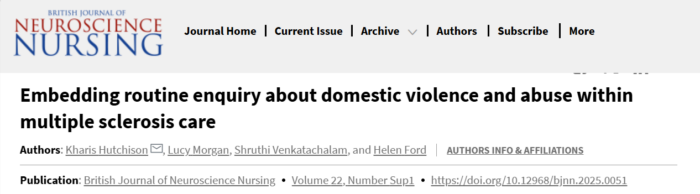 This article by key members of the MSDVA research team presents findings and reflections around the implementation of DVA routine enquiry within MS care at one NHS trust. It reflects on why and how routine enquiry questions were amended to meet the needs of patients with MS, and how MS HCPs have worked to create safe spaces for asking these questions.
People with Multiple Sclerosis's Experiences of Domestic Violence and Abuse
The Routledge Handbook of Disability, Crime, and Justice, edited by Stephen J. Macdonald and Donna Peacock, was published on 22nd May 2025. This features an open access book chapter by Kharis Hutchison, which presents a narrative review on People with Multiple Sclerosis’s Experiences of Domestic Violence and Abuse.
Hiding in Plain Sight: MS and Domestic Violence and Abuse
Published on the eve of the International Day for the Elimination of Violence against Women and Girls, this week, our project team's article "Hiding in Plain Sight: MS and Domestic Violence and Abuse", authored by Rachel Horne and Helen Ford, was published in NeurologyLive on the 25th November 2024. The article explores a critical issue: the heightened risk of individuals with multiple sclerosis (MS) to domestic violence and abuse (DVA).
The authors discuss the physical, emotional, and psychological challenges associated with MS, highlighting how DVA may go unnoticed or unreported due to the similarity between its effects and MS symptoms, making it challenging to identify cases of abuse. Additionally, the article features a powerful survivor's story, shedding light on the real-life impact of this issue.
Horne and Ford emphasise the importance of healthcare professionals in recognising signs of domestic violence and creating supportive environments for patients to disclose their experiences. The article also underscores the need for tailored support services to address the unique challenges that MS patients in abusive relationships face. For more insights into this critical topic, read the full article, "Hiding in Plain Sight: MS and Domestic Violence and Abuse."
Letter to the Editors of Neurology
Our Letter to the Editor for Neurology - referencing the work at the MS Domestic Violence and Research Initiative - was the Editors Choice!
You can read our letter here. The editors commented:
Horne et al. noted the lack of information and support regarding domestic violence and abuse for people living with MS, despite both women and people with disability being at a higher risk of such abuse. Furthermore, Horne et al. wrote about their work with the MS Domestic Violence and Abuse Research Initiative, which examined the experiences of patients who have experienced such abuse and the views of their health care staff, with the aim of developing a toolkit to guide and inform health practitioners. Responding to these comments, Dr. Michaelson expressed hope that such work will help many people and facilitate a renewed global focus on women’s health in general. This exchange highlights the important intersection of neurologic disease with domestic violence and abuse that is crucial to recognize to safeguard the well-being of our patients and their families.